Filters
Question type

Study Flashcards

If all of the coefficients in the balanced equation for an equilibrium reaction are doubled, then the value of the equilibrium constant, Kc, will also be doubled.

A) True
B) False

Correct Answer

verifed

verified

The following reaction is at equilibrium in a sealed container. N2(g) + 3H2(g) ⇄ 2NH3(g) ΔH°rxn < 0 Which, if any, of the following actions will increase the value of the equilibrium constant, Kc?


A) Adding a catalyst
B) Adding more N 2
C) Increasing the pressure
D) Lowering the temperature
E) None of these choices are correct.

F) B) and E)
G) All of the above

Correct Answer

verifed

verified

Stearic acid, nature's most common fatty acid, dimerizes when dissolved in hexane: 2C17H35COOH ⇄ (C17H35COOH) 2 ΔH°rxn = −172 kJ The equilibrium constant for this reaction at 28°C is 2900. Estimate the equilibrium constant at 38°C.


A) 4.7 × 10 5
B) 2.6 × 10 4
C) 1.9 × 10 3
D) 3.2 × 10 2
E) 18

F) A) and B)
G) B) and C)

Correct Answer

verifed

verified

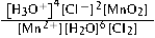
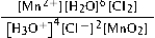
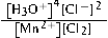
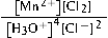
What is the mass-action expression, Qc, for the following chemical reaction? 4H3O+(aq) + 2Cl(aq) + MnO2(s) ⇄ Mn2+(aq) + 6H2O(l) + Cl2(g)


A) What is the mass-action expression, Q<sub>c</sub>, for the following chemical reaction? 4H<sub>3</sub>O<sup>+</sup>(aq)  + 2Cl<sup>−</sup>(aq)  + MnO<sub>2</sub>(s)  ⇄ Mn<sup>2+</sup>(aq)  + 6H<sub>2</sub>O(l)  + Cl<sub>2</sub>(g)  A)    B)    C)    D)    E) None of these choices are correct.
B) What is the mass-action expression, Q<sub>c</sub>, for the following chemical reaction? 4H<sub>3</sub>O<sup>+</sup>(aq)  + 2Cl<sup>−</sup>(aq)  + MnO<sub>2</sub>(s)  ⇄ Mn<sup>2+</sup>(aq)  + 6H<sub>2</sub>O(l)  + Cl<sub>2</sub>(g)  A)    B)    C)    D)    E) None of these choices are correct.
C) What is the mass-action expression, Q<sub>c</sub>, for the following chemical reaction? 4H<sub>3</sub>O<sup>+</sup>(aq)  + 2Cl<sup>−</sup>(aq)  + MnO<sub>2</sub>(s)  ⇄ Mn<sup>2+</sup>(aq)  + 6H<sub>2</sub>O(l)  + Cl<sub>2</sub>(g)  A)    B)    C)    D)    E) None of these choices are correct.
D) What is the mass-action expression, Q<sub>c</sub>, for the following chemical reaction? 4H<sub>3</sub>O<sup>+</sup>(aq)  + 2Cl<sup>−</sup>(aq)  + MnO<sub>2</sub>(s)  ⇄ Mn<sup>2+</sup>(aq)  + 6H<sub>2</sub>O(l)  + Cl<sub>2</sub>(g)  A)    B)    C)    D)    E) None of these choices are correct.
E) None of these choices are correct.

F) All of the above
G) A) and B)

Correct Answer

verifed

verified

10.0 mL of a 0.100 mol L1 solution of a metal ion M2+ is mixed with 10.0 mL of a 0.100 mol L1 solution of a substance L. The following equilibrium is established: M2+(aq) + 2L(aq) ⇄ ML22+(aq) At equilibrium the concentration of L is found to be 0.0100 mol L1. What is the equilibrium concentration of ML22+, in mol L1?


A) 0.100 mol L 1
B) 0.050 mol L 1
C) 0.025 mol L 1
D) 0.0200 mol L 1
E) 0.0100 mol L 1

F) C) and E)
G) A) and B)

Correct Answer

verifed

verified

The reaction system CS2(g) + 4H2(g) ⇄ CH4(g) + 2H2S(g) Is at equilibrium. Which of the following statements describes the behavior of the system if the partial pressure of hydrogen is doubled?


A) As equilibrium is reestablished, the partial pressure of carbon disulfide increases.
B) As equilibrium is reestablished, the partial pressure of methane, CH 4, decreases.
C) As equilibrium is reestablished, the partial pressure of hydrogen decreases.
D) As equilibrium is reestablished, the partial pressure of hydrogen sulfide decreases.
E) As equilibrium is reestablished, all the partial pressures will decrease.

F) A) and C)
G) All of the above

Correct Answer

verifed

verified

Increasing the initial amount of the limiting reactant in a reaction will increase the value of the equilibrium constant, Kc.

A) True
B) False

Correct Answer

verifed

verified

The reaction of nitric oxide to form dinitrogen oxide and nitrogen dioxide is exothermic. 3NO(g) ⇄ N2O(g) + NO2(g) + heat What effect will be seen if the temperature of the system at equilibrium is raised by 25°C?


A) The partial pressure of NO will increase.
B) The partial pressure of NO will decrease.
C) The partial pressure of NO 2 will increase.
D) The partial pressures of NO and N 2O will increase.
E) All three partial pressures will increase.

F) D) and E)
G) A) and B)

Correct Answer

verifed

verified

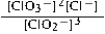
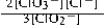
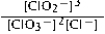
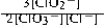
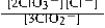
Write the mass-action expression, Qc, for the following chemical reaction. 3ClO2(aq) ⇄ 2ClO3(aq) + Cl(aq)


A) Write the mass-action expression, Q<sub>c</sub>, for the following chemical reaction. 3ClO<sub>2</sub><sup>−</sup>(aq)  ⇄ 2ClO<sub>3</sub><sup>−</sup>(aq)  + Cl<sup>−</sup>(aq)  A)    B)    C)    D)    E)
B) Write the mass-action expression, Q<sub>c</sub>, for the following chemical reaction. 3ClO<sub>2</sub><sup>−</sup>(aq)  ⇄ 2ClO<sub>3</sub><sup>−</sup>(aq)  + Cl<sup>−</sup>(aq)  A)    B)    C)    D)    E)
C) Write the mass-action expression, Q<sub>c</sub>, for the following chemical reaction. 3ClO<sub>2</sub><sup>−</sup>(aq)  ⇄ 2ClO<sub>3</sub><sup>−</sup>(aq)  + Cl<sup>−</sup>(aq)  A)    B)    C)    D)    E)
D) Write the mass-action expression, Q<sub>c</sub>, for the following chemical reaction. 3ClO<sub>2</sub><sup>−</sup>(aq)  ⇄ 2ClO<sub>3</sub><sup>−</sup>(aq)  + Cl<sup>−</sup>(aq)  A)    B)    C)    D)    E)
E) Write the mass-action expression, Q<sub>c</sub>, for the following chemical reaction. 3ClO<sub>2</sub><sup>−</sup>(aq)  ⇄ 2ClO<sub>3</sub><sup>−</sup>(aq)  + Cl<sup>−</sup>(aq)  A)    B)    C)    D)    E)

F) C) and E)
G) A) and B)

Correct Answer

verifed

verified

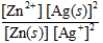
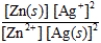
Write the mass-action expression, Qc, for the following chemical reaction. Zn(s) + 2Ag+(aq) ⇄ Zn2+(aq) + 2Ag(s)


A) Write the mass-action expression, Q<sub>c</sub>, for the following chemical reaction. Zn(s)  + 2Ag<sup>+</sup>(aq)  ⇄ Zn<sup>2+</sup>(aq)  + 2Ag(s)  A)    B)    C)    D)    E)
B) Write the mass-action expression, Q<sub>c</sub>, for the following chemical reaction. Zn(s)  + 2Ag<sup>+</sup>(aq)  ⇄ Zn<sup>2+</sup>(aq)  + 2Ag(s)  A)    B)    C)    D)    E)
C) Write the mass-action expression, Q<sub>c</sub>, for the following chemical reaction. Zn(s)  + 2Ag<sup>+</sup>(aq)  ⇄ Zn<sup>2+</sup>(aq)  + 2Ag(s)  A)    B)    C)    D)    E)
D) Write the mass-action expression, Q<sub>c</sub>, for the following chemical reaction. Zn(s)  + 2Ag<sup>+</sup>(aq)  ⇄ Zn<sup>2+</sup>(aq)  + 2Ag(s)  A)    B)    C)    D)    E)
E) Write the mass-action expression, Q<sub>c</sub>, for the following chemical reaction. Zn(s)  + 2Ag<sup>+</sup>(aq)  ⇄ Zn<sup>2+</sup>(aq)  + 2Ag(s)  A)    B)    C)    D)    E)

F) B) and E)
G) A) and B)

Correct Answer

verifed

verified

At 25°C, the equilibrium constant Kc for the reaction 2A(aq) ⇄ B(aq) + C(aq) Is 65. If 2.50 mol of A is added to enough water to prepare 1.00 L of solution, what will the equilibrium concentration of A be?


A) 0.038 M
B) 0.14 M
C) 0.28 M
D) 1.18 M
E) 2.4 M

F) C) and D)
G) All of the above

Correct Answer

verifed

verified

B

For a gas-phase equilibrium, a change in the pressure of any single reactant or product will affect the amounts of other substances involved in the equilibrium.

A) True
B) False

Correct Answer

verifed

verified

A mixture of 0.600 mol of bromine and 1.600 mol of iodine is placed into a rigid 1.000-L container at 350°C. Br2(g) + I2(g) ⇄ 2IBr(g) When the mixture has come to equilibrium, the concentration of iodine monobromide is 1.190 M. What is the equilibrium constant for this reaction at 350°C?


A) 3.55 × 10 3
B) 1.24
C) 1.47
D) 282
E) 325

F) B) and E)
G) A) and C)

Correct Answer

verifed

verified

D

The equilibrium constant, Kp, has a value of 6.5 × 10⁴ at 308 K for the reaction of nitrogen monoxide with chlorine. 2NO(g) + Cl2(g) ⇄ 2NOCl(g) What is the value of Kc?


A) 2.5 × 10 7
B) 6.5 × 10 4
C) 1.6 × 10 2
D) 1.7
E) None of these choices are correct.

F) A) and B)
G) C) and D)

Correct Answer

verifed

verified

The two equilibrium constants for the same reaction, Kc and Kp, will always equal one another when


A) all of the reactants and products are gases.
B) in the reaction equation, the number of moles of gaseous products equals the number of moles of gaseous reactants.
C) in the reaction equation, the number of moles of gaseous products is greater than the number of moles of gaseous reactants.
D) in the reaction equation, the number of moles of gaseous products is smaller than the number of moles of gaseous reactants.
E) in the reaction equation, the total number of moles of reactants equals that of the products.

F) A) and D)
G) All of the above

Correct Answer

verifed

verified

Nitric oxide is formed in automobile exhaust when nitrogen and oxygen in air react at high temperatures. N2(g) + O2(g) ⇄ 2NO(g) The equilibrium constant Kp for the reaction is 0.0025 at 2127°C. If a container is charged with 8.00 atm of nitrogen and 5.00 atm of oxygen and the mixture is allowed to reach equilibrium, what will be the equilibrium partial pressure of nitrogen?


A) 0.16 atm
B) 0.31 atm
C) 3.1 atm
D) 7.7 atm
E) 7.8 atm

F) D) and E)
G) B) and D)

Correct Answer

verifed

verified

For a gas-phase equilibrium, a change in the pressure of any single reactant or product will change Kp.

A) True
B) False

Correct Answer

verifed

verified

Hydrogen iodide, HI, is formed in an equilibrium reaction when gaseous hydrogen and iodine gas are heated together. If 20.0 g of hydrogen and 20.0 g of iodine are heated, forming 10.0 g of hydrogen iodide, what mass of hydrogen remains unreacted?


A) 10.0 g hydrogen remains
B) 10.9 g hydrogen remains
C) 15.0 g hydrogen remains
D) 19.9 g hydrogen remains
E) Need to know the equilibrium constant in order to calculate the answer.

F) B) and D)
G) A) and B)

Correct Answer

verifed

verified

Methanol can be synthesized by combining carbon monoxide and hydrogen. CO(g) + 2H2(g) ⇄ CH3OH(g) A reaction vessel contains the three gases at equilibrium with a total pressure of 1.00 atm. What will happen to the partial pressure of hydrogen if enough argon is added to raise the total pressure to 1.4 atm?


A) The partial pressure of hydrogen will decrease.
B) The partial pressure of hydrogen will increase.
C) The partial pressure of hydrogen will be unchanged.
D) K p needs to be known before a prediction can be made.
E) Both K p and the temperature need to be known before a prediction can be made.

F) C) and E)
G) B) and E)

Correct Answer

verifed

verified

Consider the equilibrium reaction: N2O4(g) ⇄ 2NO2(g) Which of the following correctly describes the relationship between Kc and Kp for the reaction?


A) K p = K c
B) K p = RT × K c
C) K p = ( RT × K c) 1
D) K p = K c / RT
E) K p = RT / K c

F) A) and D)
G) A) and B)

Correct Answer

verifed

verified

B

Showing 1 - 20 of 98

Related Exams

Show Answer