Filters
Question type

Study Flashcards

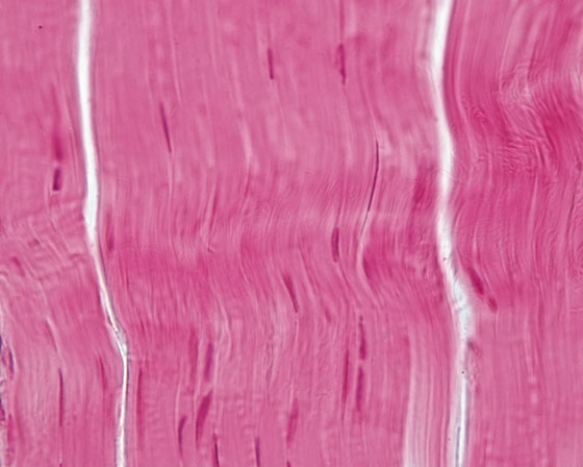
In Fig. Img_015a, a patient enters the emergency department after she fell. The emergency department physician determined that she tore a tissue in her leg. The following photomicrograph shows the torn tissue. Identify the cells whose nuclei are visible in this photomicrograph.


A) fibroblasts In Fig. Img_015a, a patient enters the emergency department after she fell. The emergency department physician determined that she tore a tissue in her leg. The following photomicrograph shows the torn tissue. Identify the cells whose nuclei are visible in this photomicrograph. A)  fibroblasts   B)  Schwann cells C)  smooth muscle cells D)  mesenchymal cells E)  macrophages
B) Schwann cells
C) smooth muscle cells
D) mesenchymal cells
E) macrophages

F) B) and E)
G) B) and D)

Correct Answer

verifed

verified

In Fig. Img_014, the large red cell in the middle of the field is responsible for which of the following conditions? In Fig. Img_014, the large red cell in the middle of the field is responsible for which of the following conditions?   A)  anaphylactic shock B)  osteoblastoma C)  leukemia D)  chondroblastoma E) . fibroma


A) anaphylactic shock
B) osteoblastoma
C) leukemia
D) chondroblastoma
E) . fibroma

F) A) and B)
G) B) and E)

Correct Answer

verifed

verified

A patient goes to the emergency department because his arm started to swell up after being stung by a wasp. Although it did not happen to this patient, the process whereby a bacterium is recognized by the cell surface receptor and internalized into the cell is referred to as


A) phagocytosis
B) exocytosis
C) pinocytosis
D) clathrin-mediated exocytosis
E) clathrin-mediated endocytosis

F) B) and C)
G) A) and E)

Correct Answer

verifed

verified

A patient goes to the emergency department because his arm started to swell up after being stung by a wasp. The exocytosis of histamine from the granules of the cells that possessed IgE receptors was due to the increased intracellular concentration of calcium. The process of calcium release was initiated by a trigger mechanism that depended on the


A) formation of IgE receptors by plasma cells
B) activation of adenylate cyclase
C) secretion of leukotrienes
D) release of preformed mediators
E) decrease in cyclic AMP levels

F) A) and E)
G) A) and D)

Correct Answer

verifed

verified

A patient goes to the emergency department because his arm started to swell up after being stung by a wasp. Which of the following cells synthesized the IgE that occupied the IgE receptors?


A) eosinophils
B) monocytes
C) T lymphocytes
D) plasma cells
E) NK cells

F) C) and D)
G) None of the above

Correct Answer

verifed

verified

In Fig. Img_015, a patient enters the emergency department after she fell. The emergency department physician determined that she tore a tissue in her leg. The following photomicrograph shows the torn tissue. What did this patient tear? In Fig. Img_015, a patient enters the emergency department after she fell. The emergency department physician determined that she tore a tissue in her leg. The following photomicrograph shows the torn tissue. What did this patient tear?   A)  dermis of the skin B)  epidermis of the skin C)  ligamentum nuchae D)  tendon E)  peripheral nerve bundle


A) dermis of the skin
B) epidermis of the skin
C) ligamentum nuchae
D) tendon
E) peripheral nerve bundle

F) None of the above
G) C) and E)

Correct Answer

verifed

verified

A patient goes to the emergency department because his arm started to swell up after being stung by a wasp. In order to eliminate possible parasites that entered the patient's connective tissue compartment when he was stung by the wasp, certain cells were recruited to the site of the lesion. Which of the following are those cells?


A) eosinophils
B) monocytes
C) T lymphocytes
D) plasma cells
E) NK cells

F) C) and D)
G) All of the above

Correct Answer

verifed

verified

A patient goes to the emergency department because his arm started to swell up after being stung by a wasp. Although it did not happen to this patient, in some individuals the smooth muscles of the bronchioles may undergo prolonged contraction resulting in possible respiratory distress. Which of the following pharmacologic agents released by the cells that possess IgE receptors is responsible for contraction of the bronchiolar smooth muscles?


A) heparin
B) chondroitin sulfate
C) aryl sulfatase
D) prostaglandin
E) thromboxane A2

F) A) and C)
G) C) and D)

Correct Answer

verifed

verified

A patient goes to the emergency department because his arm started to swell up after being stung by a wasp. Prostaglandins released by the cells that possess IgE receptors were


A) synthesized in the cytosol
B) stored in vesicles
C) synthesized from cholesterol
D) synthesized from arachidonic acid precursors
E) modified in the Golgi apparatus

F) C) and E)
G) B) and D)

Correct Answer

verifed

verified

A patient goes to the emergency department because his arm started to swell up after being stung by a wasp. In order to eliminate possible bacteria that entered the patient's connective tissue compartment when he was stung by the wasp certain cells were recruited to the site of the lesion. Which of the following are those cells?


A) eosinophils
B) monocytes
C) neutrophils
D) plasma cells
E) NK cells

F) B) and E)
G) B) and D)

Correct Answer

verifed

verified

C

A patient goes to the emergency department because his arm started to swell up after being stung by a wasp. IgE receptors are present on which cells of this patient?


A) eosinophils
B) mast cells
C) T lymphocytes
D) plasma cells
E) NK cells

F) B) and E)
G) A) and C)

Correct Answer

verifed

verified

B

In Fig. Img_012, classify the tissue presented in the accompanying photomicrograph. In Fig. Img_012, classify the tissue presented in the accompanying photomicrograph.   A)  dense regular collagenous connective tissue B)  dense irregular collagenous connective tissue C)  loose connective tissue D)  dense regular elastic connective tissue E)  mucoid connective tissue


A) dense regular collagenous connective tissue
B) dense irregular collagenous connective tissue
C) loose connective tissue
D) dense regular elastic connective tissue
E) mucoid connective tissue

F) None of the above
G) A) and B)

Correct Answer

verifed

verified

C

Showing 1 - 12 of 12

Related Exams

Show Answer